Category: Podcast

  • (Why) We Love Physics (Teaching)

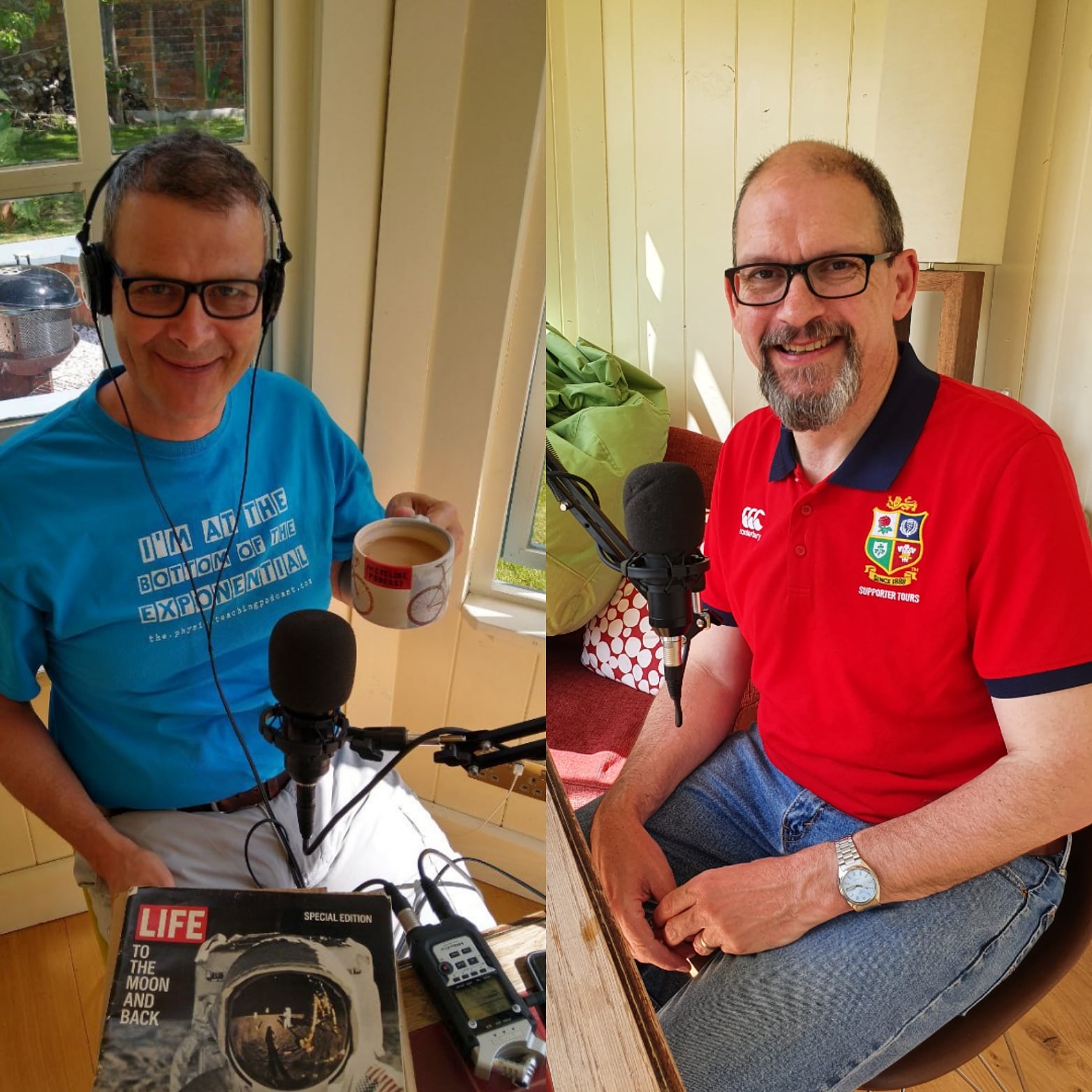
    100 not out! Thomas and Robin salute the balcony with a good old-fashioned ramble about what excites them about physics teaching, making the subject live if you’re not a specialist and the challenges of teaching science in a ‘post-truth’ world.
    Image
    Thomas — Robin

    We go round ALL the houses, and talk about where our love from physics comes from, but we’ve distilled out the most eclectic links list we have ever produced! Here it is…

    Links

    Join in!

    Please share ideas or successes – or indeed questions by messaging us on BlueSky: https://bsky.app/profile/physicstp.bsky.social .  You can also message us via our website contact form on every page of the web site at  the.physicsteachingpodcast.com, or email using the address given in the podcast (if we remember). We are moving away from X but can be found there as @physicstp.

    Music

    The music is used under the Attribution-NonCommercial 3.0 International License

  • Bad Movies for Good Lessons

    Bad Movies for Good Lessons

    We talk through bad movies to support good Physics Teaching. the aim is to talk through ones people suggest that are actually usable in lessons. As usual we get excited and make a few mistakes. Thomas is pretty sure that aeroplanes are made of aluminium, not steel and there were a few mentioned (Ant Man, Hulk) that we forgot to cover.

    Links are below.

    Sorry for the brief notes. Like you, we have a billion papers to mark for the TAGs/CAGs.

    Links

    Join in!

    Please share ideas or successes – or indeed questions by messaging us on BlueSky: https://bsky.app/profile/physicstp.bsky.social .  You can also message us via our website contact form on every page of the web site at  the.physicsteachingpodcast.com, or email using the address given in the podcast (if we remember). We are moving away from X but can be found there as @physicstp.

    Music

    The music is used under the Attribution-NonCommercial 3.0 International License

  • Techognition

    Techognition

    We meet Paul Cook stellar technician, Honorary Fellow of the Institute of Physics and tireless promoter of professional recognition for technicians. Paul is the senior lead technician at Ark Burlington Danes Academy and lead technician for the Ark Academy network.

    He has worked as a senior/head technician for many years in various schools in Essex and across London covering all three sciences to A-level but with a specialism in physics.

    He is an Association for Science Education (ASE) technician committee member and registrant champion for the Science Council and was The Ogden Trust’s first technician fellow.

    Read more about his honorary fellowship here, or see his LinkedIn profile here.

    Paul’s advice is straightforward in getting the most out of your relationship with your technician colleague

    • talk to your colleague. Discuss how you can help each other. Your technician colleague will often have built up years of experience and your teaching can benefit from their expertise.
    • include your technician colleague in your planning. Involve them in your teaching: can they help you with demos? Can they help students overcome technical difficulties?
    • ensure CPD for technicians. It’s easy to focus CPD sessions on your teaching staff, but Paul stresses the importance of allowing technicians to build their expertise through practical, hands-on training.

    … and with CPD in mind, Technognition’s annual celebration and showcase for school science technicians is happening on June 11th (link below!). For those that don’t know, Techognition is an organisation that Paul is heavily involved with. It celebrates the work of school and FE college technicians and promotes their professional recognition.

    Thanks so much to Paul for dealing with some dodgy data links and persevering anyway.

    Links

    Join in!

    Please share ideas or successes – or indeed questions by messaging us on BlueSky: https://bsky.app/profile/physicstp.bsky.social .  You can also message us via our website contact form on every page of the web site at  the.physicsteachingpodcast.com, or email using the address given in the podcast (if we remember). We are moving away from X but can be found there as @physicstp.

    Music

    The music is used under the Attribution-NonCommercial 3.0 International License

  • The Joy of Simple Things (Colour and Light)

    The Joy of Simple Things (Colour and Light)

    A short chat about the joy of teaching classic ideas with simple props like light boxes, mirrors and lenses.

    Light boxes

    Now we’d better get back to that CAG marking.

    Links

    Join in!

    Please share ideas or successes – or indeed questions by messaging us on BlueSky: https://bsky.app/profile/physicstp.bsky.social .  You can also message us via our website contact form on every page of the web site at  the.physicsteachingpodcast.com, or email using the address given in the podcast (if we remember). We are moving away from X but can be found there as @physicstp.

    Music

    The music is used under the Attribution-NonCommercial 3.0 International License

  • TAG, Mass and Weight

    TAG, Mass and Weight

    The teacher assessed grade plan has thrown a curveball at the profession, leaving teachers scratching their head on what exactly is needed as ‘evidence’ to support the grade that they award. Of course, we are particularly worried about those teachers who wouldn’t call themselves physics specialists but are assessing grades anyway. Thomas and Robin discuss a few strategies you might use.

    Once again, the profession is being asked to go above and beyond, and as always, we will rise to the challenge, but make sure you take care of yourselves and remember the maxim: good enough is good enough.

    Mass and Weight are a perennial source of confusion for students, and it would seem national newspapers (see the Guardian article below). Thomas appeals for advice on how to untangle this confusion. Please do get in touch if you have any insights.

    Meanwhile, as we home in on our 100th episode, we are once again asking YOU to get involved. Teachers learn the most from other teachers, so please put your experience out there by getting in touch and guesting on the podcast… it’s either that or you’ll have to listen to more from us two, so that should be incentive enough.

    Links

    Join in!

    Please share ideas or successes – or indeed questions by messaging us on BlueSky: https://bsky.app/profile/physicstp.bsky.social .  You can also message us via our website contact form on every page of the web site at  the.physicsteachingpodcast.com, or email using the address given in the podcast (if we remember). We are moving away from X but can be found there as @physicstp.

    Music

    The music is used under the Attribution-NonCommercial 3.0 International License

  • Playing with Beats

    Playing with Beats

    Thomas was interested in how the brain makes its own beat, and put together this little two minute sound test. You’ll need headphones to appreciate it properly, but it is interesting to listen to on speakers as well.

    Join in!

    Please share ideas or successes – or indeed questions by messaging us on BlueSky: https://bsky.app/profile/physicstp.bsky.social .  You can also message us via our website contact form on every page of the web site at  the.physicsteachingpodcast.com, or email using the address given in the podcast (if we remember). We are moving away from X but can be found there as @physicstp.

    Music

    The music is used under the Attribution-NonCommercial 3.0 International License

  • Ways to teach… Sound (ish)

    Ways to teach… Sound (ish)

    The marvellous David Cotton (@Newmanphysics) joins us to enthuse about teaching sound. We sailed down the river of KS3 Sound, but couldn’t help exploring up the sides of the valley to see what we could extract from David’s vast experience of teaching.

    Thank you so much wonderful physics teaching community for all the tips tricks and techniques that you use to make sound live for your students. It is clear that there are dozens of ways to engage them in this topic. You’ll find links to the myriad ideas discussed at the bottom of this page, but don’t forget to listen as well. David’s enthusiasm is more infectious than… than… Oh, if only there was a fitting simile for something infectious in the national consciousness.

    We tried to stick to KS3 but couldn’t resist a little journey into other levels too! Marvin and Milo will help you if you are a primary teacher; a discussion of beats is probably focused more on stretch and challenge at A-level. Who says the podcast doesn’t give you full value for money? Oh yes, free, and worth every penny.

    Have a great Easter break!

    Links

    Making beats with audacity

    1. Install audacity, it is free (and there are versions for Windows, Apple and Linux).
    2. Make tones with the Generate menu:
      1. Generate >> Tone… (Set to 400 Hz and Amplitude to 0.3*)
      2. Deselect the wave you made by clicking underneath it in the grey area
      3. Generate >> Tone… (Set to 401 Hz and Amplitude to 0.3)
    3. You can zoom in to see the waves with the magnifying glass (1)
    4. You can Play the tones individually using the Mute and Solo buttons (2)
    5. You can force them to left and right channels too if you want to try headphones (3)
    6. To mix them to a new track:
      1. CTRL+A to select both the tracks (they will go white)
      2. Tracks >> Mix and render to new track

    *if it is above 0.5 then the combined wave will be higher than the maximum of 1.0 and very very loud.

    Note the visual beat (moiré) in the pictures which is caused (we think) by the resolution of the monitor on which this screen grab was taken.

    Join in!

    Please share ideas or successes – or indeed questions by messaging us on BlueSky: https://bsky.app/profile/physicstp.bsky.social .  You can also message us via our website contact form on every page of the web site at  the.physicsteachingpodcast.com, or email using the address given in the podcast (if we remember). We are moving away from X but can be found there as @physicstp.

    Music

    The music is used under the Attribution-NonCommercial 3.0 International License

  • GCSE Long Answers and MyMarkingMachine.com

    GCSE Long Answers and MyMarkingMachine.com

    We first met tonight’s podcast guest in a different world. A time of handshakes, going to places like offices and restaurants (places to work and eat in case you’ve forgotten). Back then, he was just setting out on his journey investigating how AI can help with student assessment. We were excited, and so we are delighted to be joined by Mark Robinson (@mark_robo) of mymarkingmachine.com.

    Mark has been developing his AI marking system for two years now, so he has though more deeply than most about, assessment and how students construct a good answer to a written question, so when he heard our discussion with Carole Kenrick a couple of weeks ago, he got in touch to talk us through some of the methods he uses to put Carole’s recommendations into practice. Check out the FIFA method in the links section below. If you want to know more, you can catch up with Mark at the IOP online teaching CPD which we’ve linked to below.

    Mark’s AI marking machine is now online, so check out the links below and sign up to try it – you’ll be impressed! Mark has added something new to the mix: the ability to provide students with instant feedback, on demand, but leaving the teacher free to target their support where it is most needed.

    Oh, and anyone fancy seeing a floating tanker? Some nice physics for our class with a discussion of a “superior mirage” that caused an oil tanker to appear to float above the horizon.

    Links

    Interactives

    Join in!

    Please share ideas or successes – or indeed questions by messaging us on BlueSky: https://bsky.app/profile/physicstp.bsky.social .  You can also message us via our website contact form on every page of the web site at  the.physicsteachingpodcast.com, or email using the address given in the podcast (if we remember). We are moving away from X but can be found there as @physicstp.

    Music

    The music is used under the Attribution-NonCommercial 3.0 International License

  • Covid Legacies: helping trainee teachers

    Covid Legacies: helping trainee teachers

    We are delighted to be joined by the inspirational David Cotton to talk about supporting trainees who have missed out so much during the pandemic. Those who know David will know what a tireless champion of physics teaching he is. A genuine enthusiast, David is one of the ‘must follow’ list for physics teachers.

    We have focused a lot on the effect on students and teaching, but David rightly points out that PGCE trainees and NQTs have had an impoverished introduction to the profession, and it is something we might bear in mind when our new generation of teaching heroes hit the classrooms over the next few months.

    Some of the points we discussed to help are:

    • Join the IoP, or at least make sure your school is an affiliate
    • If your department is hosting a trainee, or you have an NQT in your department, look for opportunities to allow them to see other teachers, and for experienced teachers to support them.
    • If you are a trainee or NQT, don’t worry, you have time on your side. Lean on your mentor and colleagues, and befriend your technician. Together they will help you to develop your classroom practice, as well as your repertoire of teaching tools and experiments.

    David will re-join us soon for a ways-to-teach episode on sound – we can’t wait!

    Links:

    IoP Spark

    IoP affiliate programme for schools

    Join in!

    Please share ideas or successes – or indeed questions by messaging us on BlueSky: https://bsky.app/profile/physicstp.bsky.social .  You can also message us via our website contact form on every page of the web site at  the.physicsteachingpodcast.com, or email using the address given in the podcast (if we remember). We are moving away from X but can be found there as @physicstp.

    Music

    The music is used under the Attribution-NonCommercial 3.0 International License

  • Covid Positives

    Covid Positives

    Thomas and Robin are joined by podcast stalwart and all-round hero of physics teaching, Patrick Kaplo from Wyndham, New Hampshire to follow up on a question he asked way back at the beginning of the Covid crisis, almost 1 year ago now, namely “How will this change our practice?”

    We discuss some ways in which we’ll never “go back” to pre-pandemic teaching before hearing from some students about what they thought was successful in terms of lockdown teaching methods

    Some of the highlights of the discussions included:

    • online tools. Nearpod, Plickers, Quizlet and Kahoot all get a mention. More inventive ways to do our Assessment for Learning both in and out of class.
    • Microsoft Forms (and google forms) deserve a bullet-point all of their own, given Forms’ inclusion in Teams and mature interface that makes feedback and marking a breeze.
    • Platforms. Microsoft Teams, with its breakout rooms, ability to record lessons and ubiquity has been popular with teachers and students and has enabled novice and experts to collaborate and find new ways of teaching.
    • Asynchronous teaching. A grand term maybe, but the ability to record lessons or lesson segments, review them and take learning at the individual’s pace is powerful, and a gamechanger for students and teachers. Students pointed out that this didn’t need to be a high-tech solution, just having access to the lesson PowerPoint made a difference, allowing students to go at their own pace.
    • The added structure of the online lessons helped students in developing motivation and building confidence. Those students who were ‘teaching assistants’ (for listeners outside the USA, these are students who help teach younger ages) particularly found access to lesson materials useful.

    We tried to stick to positives but there were some notes of caution. The pandemic and the intense screen time has been tiring for students and they valued time away from the online learning, so variety is still important. New methods also bring the odd disadvantage as well, so make sure new techniques work for you and your students, not the other way around!

    Join in!

    Please share ideas or successes – or indeed questions by messaging us on BlueSky: https://bsky.app/profile/physicstp.bsky.social .  You can also message us via our website contact form on every page of the web site at  the.physicsteachingpodcast.com, or email using the address given in the podcast (if we remember). We are moving away from X but can be found there as @physicstp.

    Music

    The music is used under the Attribution-NonCommercial 3.0 International License